
Weigh every word on the gold scales – This idiom alludes to the extremely sensitive precision scales that were used to weigh gold dust, coins or pieces of jewelry as accurately as possible in the past. In terms of linguistic history, the image is old: it can already be found in antiquity, among others in Varro and Cicero, and was also spread into everyday language in the 16th century through Martin Luther’s use of language. The meaning: words should be weighed up as carefully as we do with the precious metal gold.
Whether a scale is used in the precious metal trade, a pawn shop or by a jeweler to weigh jewelry – what counts in the end is that the weighing result is reproducible, plausible and reliable in the process.
Precision has a history
The fact that precious metals have to be weighed precisely is of course not a new idea. There is evidence of balance scales in Egypt since ancient times; Egyptian weights are archaeologically documented for the gold trade in particular. However, the great technical leap to modern precision weighing came much later: it was the further development of mechanical precision scales with knife-edge bearings in the 18th and 19th centuries that made highly reproducible precision weighing possible.


The stories surrounding the carat are also interesting. The term is traditionally associated with the carob tree and its seeds. Originally, the dried carob seed was regarded as a natural reference value – partly because it was considered to have a particularly uniform size and weight of around 0.2 grams . However, the matter was not quite so clear-cut: more recent studies show that the mass of these seeds varies considerably. It is therefore likely that not only the seed itself played a role as a descriptive standard of comparison, but also the human ability to practically assess small differences in weight.
In the Middle Ages, the carat was also used in relation to grains of wheat; it was widely believed that one carat was equivalent to the weight of three grains of barley or four grains of wheat. However, the measure was not standardized for a long time. Until the beginning of the 20th century, carat definitions differed from country to country, sometimes significantly. In order to standardize the gemstone and precious metal trade , the Comité International des Poids et Mesures (CIPM) finally introduced the metric carat was introduced by the Comité International des Poids et Mesures (CIPM) in 1907 – with the exact value of 0.2 g that is still used today.
However, a second meaning is important for the gold trade: carat does not refer to the weight, but to the fineness of a gold alloy. Pure gold corresponds to 24 carats. 18 carats stands for a fineness of 750/1000, 14 carats for 585/1000. This distinction is particularly important in the purchase discussion because weight and gold content are two different values: The scales record the weight, the carat value of the alloy determines how much fine gold is actually contained.
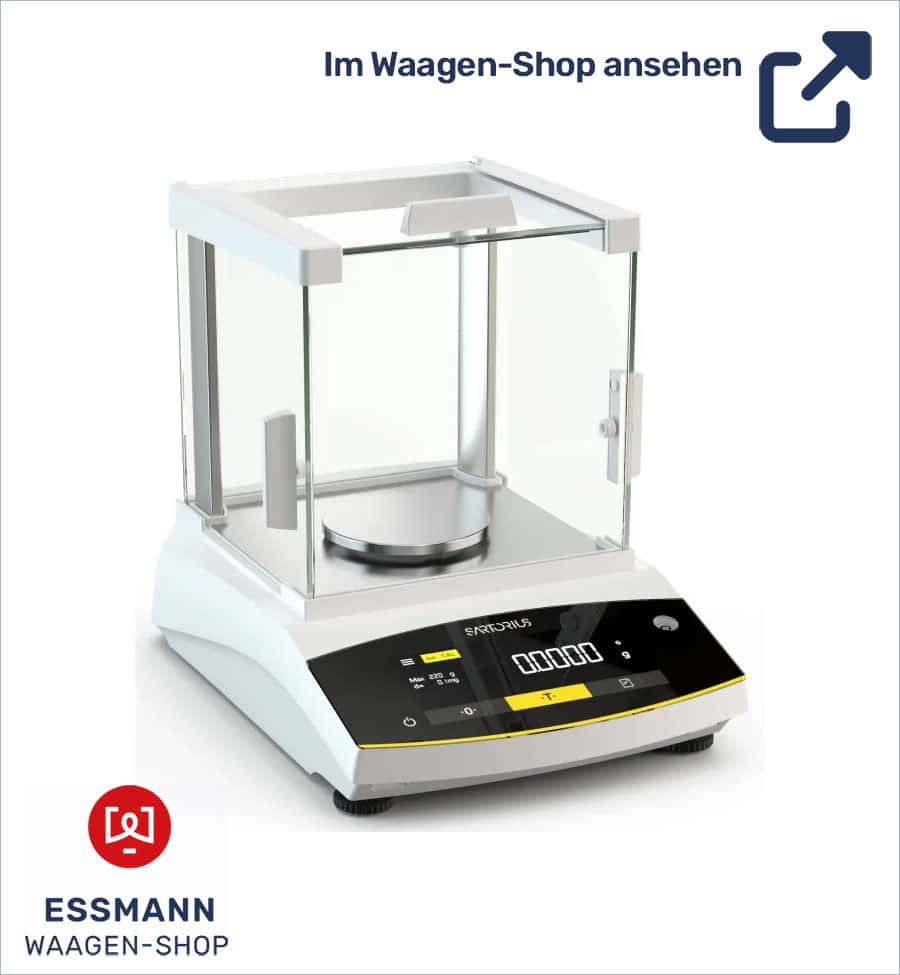
Today, electronic non-automatic precision scales dominate the gold and gemstone trade. Depending on the model, they have internal adjustment functions that adjust automatically or time-controlled.
Legal certainty: essential in retail
Anyone who bills gold, jewelry or precious metals commercially by weight is working in the course of business and requires a measuring device that complies with calibration law. The correct term for new scales is often not calibrated, but conformity assessed. This conformity assessment generally replaces the previous one when the product is placed on the market for the first time. Manufacturer’s marking. After this conformity assessment, the regular calibration periods apply.
As a rule, non-automatic weighing instruments in the retail sector in Germany are subject to a verification period of two years. The period begins with the year of placing on the market or the last calibration; the period typically ends on December 31 of the year of expiry. Since January 1, 2025, however, the previous notification obligation for newly commissioned measuring devices no longer applies. This does not affect the calibration obligation itself. If you want to keep track of the many scales to be calibrated in your company without any effort, you can outsource this task to weighing specialists such as ESSMANN or VISSER scales Rhine-Ruhr handover: You keep an eye on all the scales in your care, remind you of calibration dates and take care of maintenance and calibration
For legally compliant operation , the scales should have at least the following: CE marking, metrology marking M, appropriate accuracy class, valid conformity assessment or verification and use within the approved area of application.
Verifiable means not calibrated
The fact that a scale is calibratable does not mean that it is automatically sold calibrated.
If you want to use the scales for commercial gold trading, you must order them directly “with verification” (or conformity assessment). Subsequent initial verification by the verification office is often no longer possible without further ado if the scales have left the manufacturer’s factory uncalibrated.
When purchasing legal-for-trade scales, the verification (conformity assessment) should therefore always be booked if they are to be used for trade.
Different applications: Where which scale makes sense
In terms of calibration law and practice, it is important to differentiate between the environment in which the scales are used.
1. laboratory and research
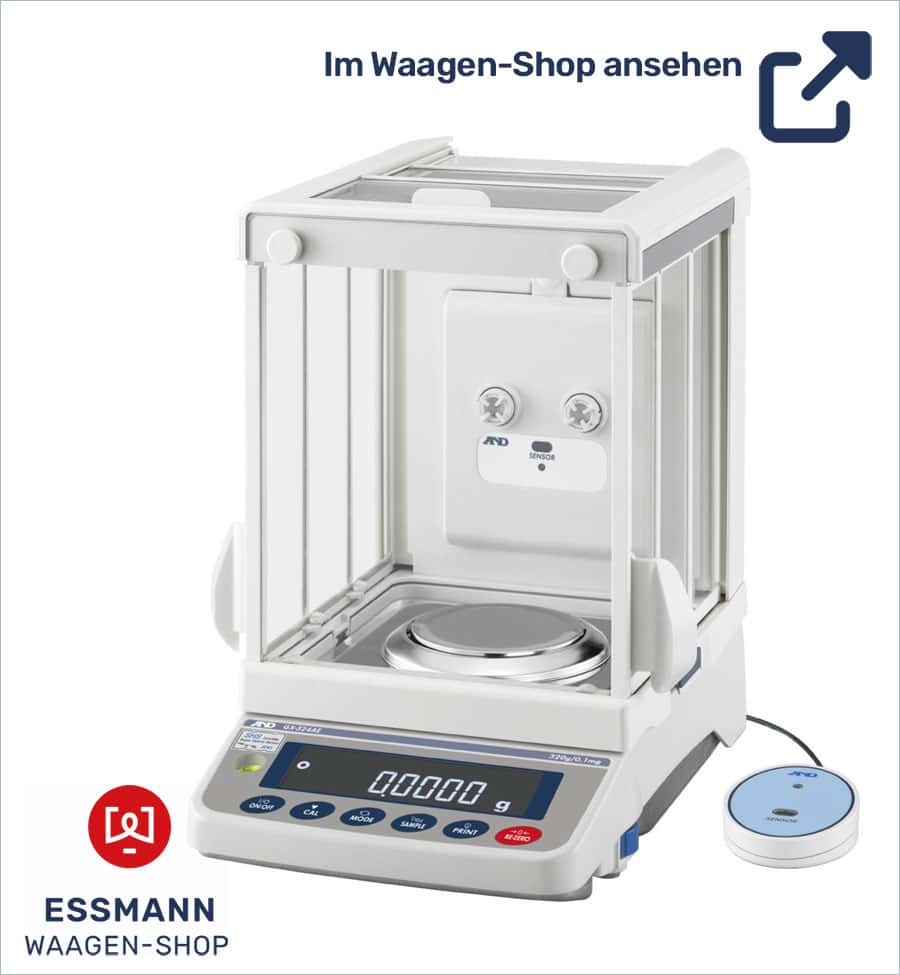
This involves high-precision weighing, analysis, formulations or material testing under controlled conditions. Typical laboratory balances or analytical balances with very fine resolution, draft shield and internal adjustment. The focus is on precision and reproducibility.
2. precious metal trading outside of open sales outlets
In this area, gold, jewelry or other precious metals are weighed for business purposes and therefore also subject to legal metrology, but not at a sales counter that is openly visible to walk-in customers. A typical example is a gold buyer who values goods in an internal testing or office room, or a precious metal dealer who carries out purchases and checkweighing in a back office that is not open to the public. The focus here is on precise weight determination, documentation and material evaluation.
The following requirements must be met by the scales: min = 0.5 g, d = 0.01 g, e = 0.1 g.
3. open points of sale
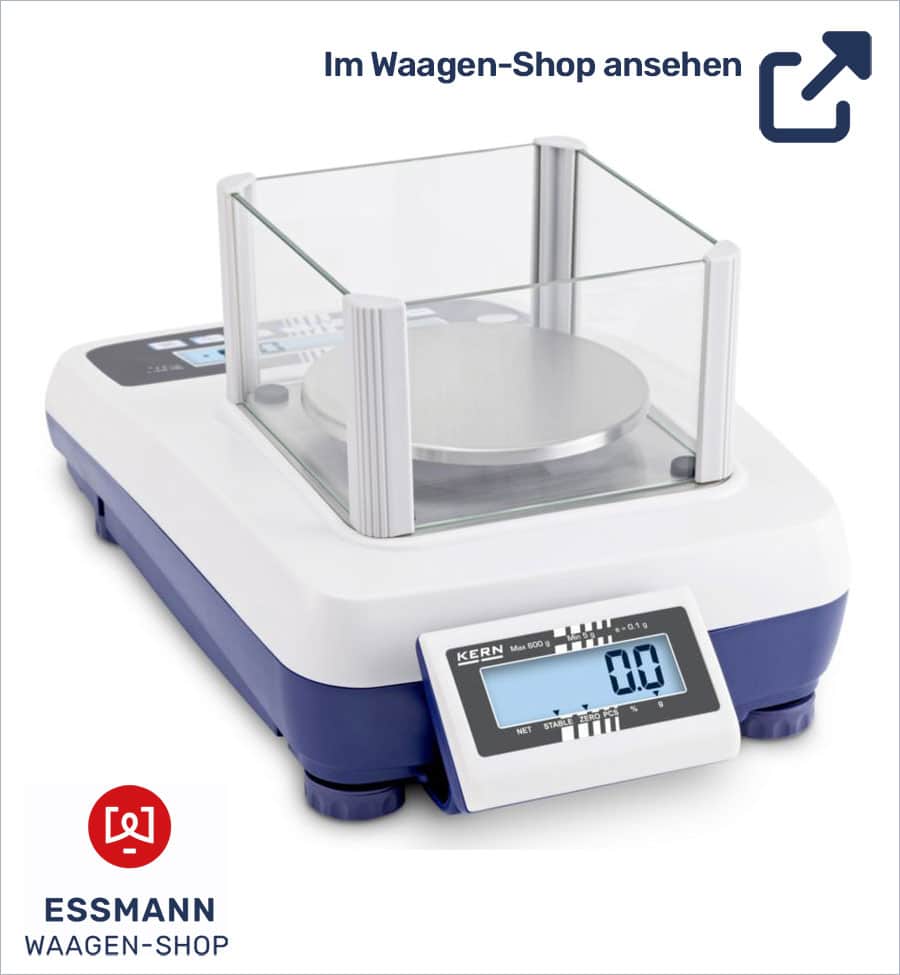
An open point of sale is when the purchase or sale takes place in publicly accessible rooms and the customer can follow the weighing process directly – for example at the sales counter of a jeweler, in a pawn shop or in a gold purchase branch with a customer area. In these cases, stricter requirements apply to the scales: the displayed value must be fully visible to the buyer and seller at the same time, for example by means of a second display facing the customer. And the display must not convey any unacceptable fictitious accuracy.
The following requirements must be met by the scale: e = d.
In sales: No false accuracy due to auxiliary displays
In practical terms, this means that some precision scales also display a particularly fine last digit. This additional display is called an auxiliary display. It can be useful in the laboratory or for internal work because the smallest changes become more visible. In customer business, however, this can be tricky if this finer display could be interpreted as a binding billing value . For this reason, it is not the most technically impressive last digit on the display that counts in sales, but the value that is legally binding and clearly recognizable for both parties. Scales that do not meet these requirements are not permitted for open points of sale.
Which accuracy class makes sense for gold scales?
It is worth taking a differentiated view here. The The OIML system and the classes I to (IIII) used in Europe do not say in general terms: gold trade equals class II, precious stones equals class I.
Class I is the highest accuracy class, Class II the high accuracy class. Class II balances are suitable for many jewelry and precious metal applications; for certain very fine applications, especially in the laboratory or high-resolution gemstone sector, Class I may be useful or necessary.
It is not the class alone that is decisive, but the interaction of the maximum weighing range [max], readability/digit increment [d], calibration value [e] and minimum load [min]. This tells you whether a scale is really suitable in practice.
Accuracy according to application
Not every gold scale is suitable for every operation. Decisive factors are readability, weighing range, minimum load and accuracy class.
| Field of application | Typical requirement | Frequently matching class |
|---|---|---|
| Old gold purchase, pawnshop, coins | Robust fine weighing with legally compliant minimum load | II |
| Jeweler, precious stones, very small pieces | Very fine resolution, small weighing range | I or II |
| Goldsmiths, alloys, workshop | Precision plus robust suitability for everyday use | I or II |
The following applies to gold purchasing: A large weighing range sounds practical at first, but often comes at the expense of fine, legally compliant weighing of small quantities. In case of doubt, a suitably specified smaller scale is the better economic decision.
Minimum load: One of the most important practical points for gold scales
The minimum load [min] results from the accuracy class and calibration value [e]. For class II scales, it depends on the respective verification value range. This is exactly where the actual purchase recommendation comes from: If you want to weigh very small pieces of jewelry, broken gold or individual components with legal certainty, you must not only look at the maximum weighing range, but also specifically at a sufficiently small minimum load and a verification value suitable for the application. This is because weighing below Min is not legally permitted for commercial use. Otherwise, there may be a scale on the counter, but where the business actually takes place, there is no reliable and permissible measuring range.
Useful functions – and where the limits lie
Tare, stable data interfaces and a practical unit logic are indisputably useful. In precious metals trading, the relevant ounce unit is the troy ounce (31.1035 g). For precious stones, the carat with 0.2 g is decisive.
Data interfaces are more than just a convenience feature, especially in gold buying and pawnshops. If prices are determined on the basis of weight, the process must remain traceable in the event of a dispute, during internal audits or as part of money laundering and commercial documentation obligations. The Money Laundering Act does not expressly require every single weighing result to be stored in a specific technical form. However, it does require the recording and storage of relevant information on transactions and transaction receipts. A digital transfer of the weighing results to software, printers or merchandise management systems therefore helps to document purchasing processes cleanly, reduce sources of error and make price determination traceable.
Internal adjustment weights are also very useful. They increase convenience and repeatability, especially in the event of temperature changes or changes of location. Class I and II precision scales react sensitively to the installation location. If there is no internal automatic calibration system, the scale must be calibrated manually with test weights at the respective location. Internal calibration weights make this process much easier and help to keep the measuring accuracy constant in everyday use. However, they do not replace the legal conformity assessment or the timely calibration.
Density determination: Useful additional function
Underfloor weighing to determine density is a good additional test method, especially for alloys, plausibility checks and material deviations. However, it is not the only reliable method for the non-destructive detection of high-quality counterfeits. Several methods should be combined, especially for demanding testing tasks. In practical terms, this means for a jewelry or gold purchasing counter: underfloor weighing is a plus point, but no substitute for a clean testing concept.
Gold scales in the workshop: Special requirements
A gold workshop places special demands on robustness, ease of maintenance and cleaning – filing dust, polishing paste, acids and heat are part of everyday life here. Removable weighing elements and a design without unnecessary dirt traps help to prevent the loss of valuable abrasion and keep the scales permanently precise.
It is therefore important to have an easy-to-clean design, smooth and easily accessible weighing surfaces, an installation location that is as protected as possible and a low-vibration, thermally stable environment. A draft shield is also essential for fine-resolution scales, as even air movements can distort the result.
Checklist: What your gold scales should have
It is worth taking a systematic look at these criteria before making a purchase:
- Suitable accuracy class for the specific application
- Valid conformity assessment or calibration for legally compliant operation
- CE marking and metrology marking M
- Calibration value, readability and minimum load matching the actual weighing range
- Customer display or clearly visible display in open counter operation
- Internal adjustment function for more everyday safety
- Unit changeover for grams, carats and troy ounces
- Data interface for printer, POS system or software connection
- Wind protection for fine-resolution devices
- Workshop-compatible, easy-to-clean design for use in the goldsmith’s workshop
Proven manufacturers at a glance
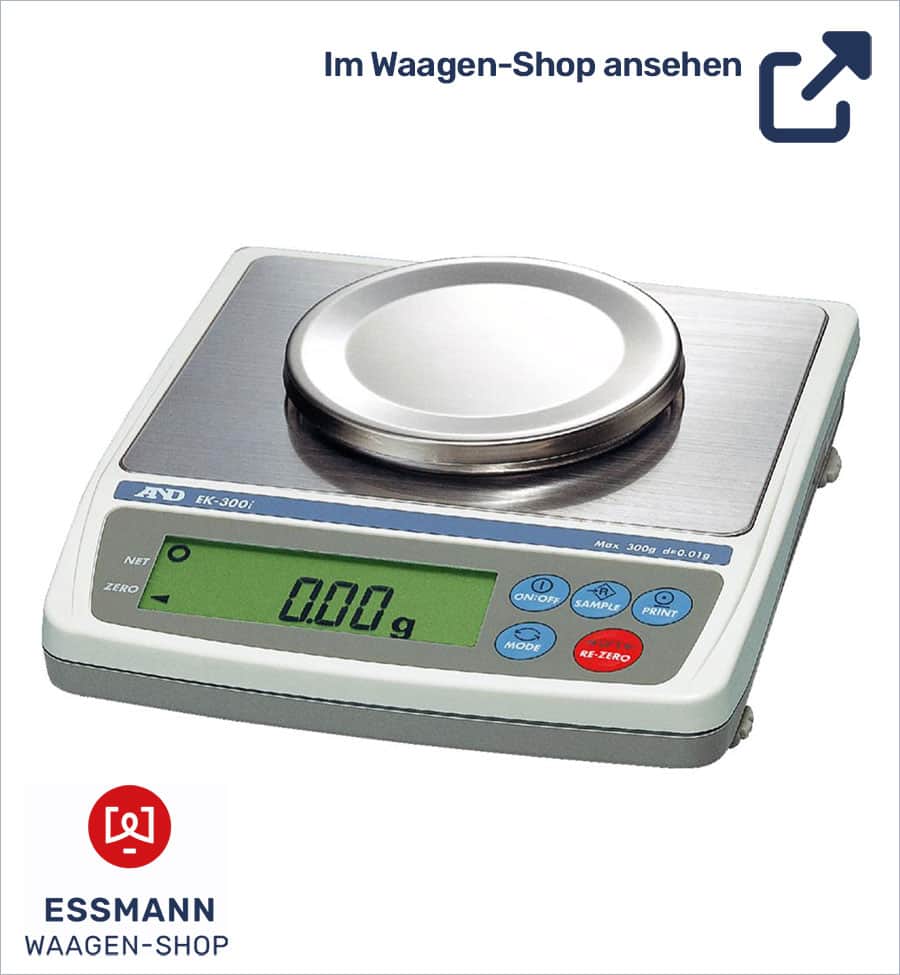
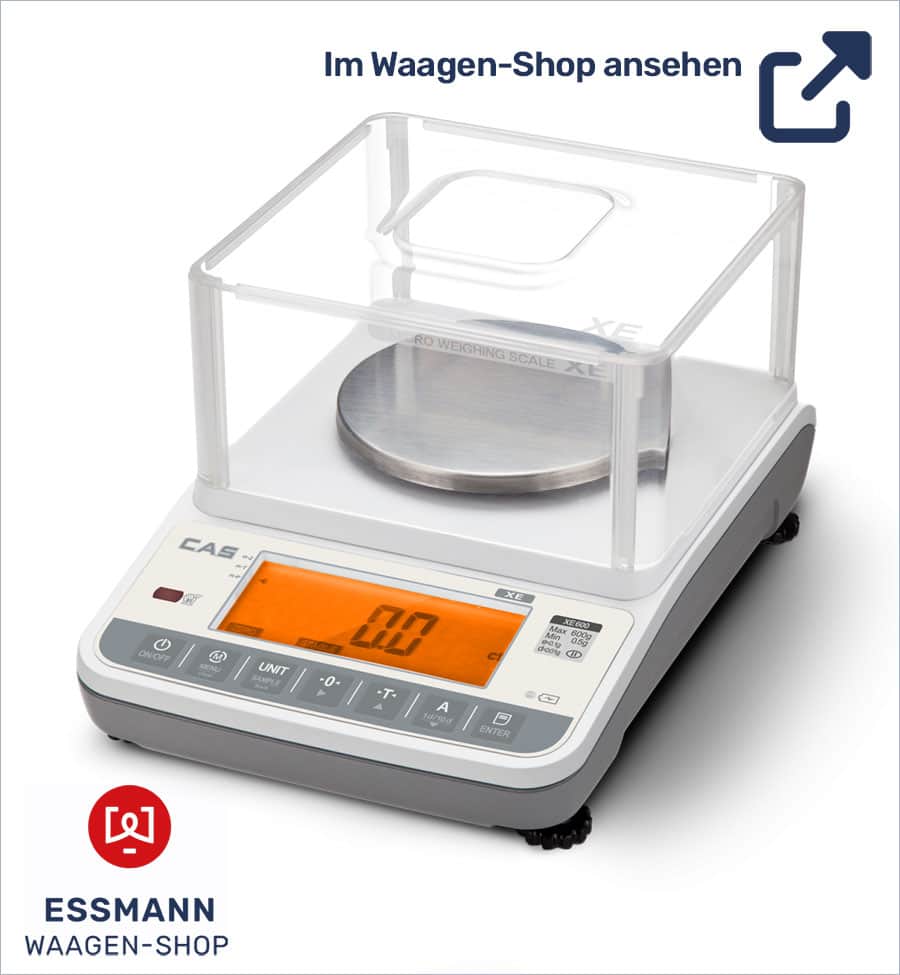
In the professional segment, manufacturers who document their devices properly and specify them for legally compliant use are of particular interest. These include, for example, KERN with Class II precision scales for counter operation and Sartorius with high-precision legal-for-trade solutions in the laboratory and ultra-fine range. CAS and A&D offer a good price-performance ratio.
More important than the brand name alone, however, is whether the specific model is suitable for your own application . A good gold scale is a tool that must function reliably and legally in the decisive measuring range.
Costs and overall calculation
The cost of a professional gold scale depends heavily on the accuracy class, features and area of application. Simple to mid-range Class II devices can start in the low to mid three-digit range. High-quality legal-for-trade analytical scales are significantly more expensive.
In addition to the purchase, there are ongoing costs, such as for calibrations, test weights if necessary, cleaning, accessories such as printer rolls and the organizational effort involved in location, maintenance and documentation. If you set these costs against the risk of incorrect or legally contestable measurements, you will quickly realize that a professionally selected gold scale is not a minor matter, but the basis of a reliable business process. A strong partner such as a specialist weighing company, which takes care of maintenance and calibration, takes the pressure off a scale operator and, in the event of a failure, also provides an uncomplicated replacement during the repair.
In short
You don’t buy the right gold scale based on a gut feeling, but on the measuring task, minimum load, calibration value, process environment and legal framework. If you define this clearly, you get a device that can be used for everyday billing – and that is exactly what matters in the gold business.
FAQ: The answers to the most important questions about buying a gold scale
What is a carat scale?
A carat scale is a particularly fine-resolution scale used for weighing gemstones, jewelry or small quantities of precious metals. The term is widely used in everyday life, but technically it is not entirely clear-cut. It usually refers to a precision scale that can reliably display very small weights – often in grams or carats.
What does carat mean for gemstones and gold?
A clear distinction must be made here: For gemstones, the carat is a unit of weight. One carat corresponds to exactly 0.2 g. With gold, on the other hand, carat usually refers to the fineness of an alloy, for example 24 carat for almost pure gold or 18 carat for an alloy with 75 percent gold content. In everyday life, the two meanings are often mixed up – technically, they should be clearly distinguished.
What does “non-automatic” mean for scales?
Non-automatic means that the load to be weighed is manually applied to and removed from the scale. This is the classic case with gold scales, jewelry scales or laboratory scales. In contrast, automatic scales work largely automatically, for example in industrial conveying or filling processes.
What is a cutting edge warehouse and is it still relevant today?
The knife-edge bearing is a central component of classic mechanical precision scales. A balance beam rests on very finely machined cutting edges, i.e. sharp-edged bearing points, which minimize friction and thus enable precise measurements. Historically, this was a major advance in precision weighing. Today, the knife-edge bearing mainly plays a role in historical, mechanical or museum precision scales. In the modern gold trade, electronic scales with other measuring technology dominate.
What is the difference between adjustment and calibration?
These terms are often confused. During adjustment, a scale is set so that it measures as correctly as possible. This involves actively intervening in the measuring behavior. Calibration, on the other hand, involves checking and documenting how much the display deviates from the correct value – without changing the device. In short: adjustment improves, calibration checks.
What are accuracy classes – and which are relevant for gold scales?
Accuracy classes classify scales according to how precisely they work in terms of design and measurement technology. Classes I and II are particularly relevant for non-automatic weighing instruments. Class I stands for very high precision, for example in the laboratory or for very fine applications. Class II is the high accuracy class and is suitable for many applications in jewelry stores, gold purchasing and precious metal trading. Which class is required depends not only on the goods, but also on the specific measuring task.
What is the weighing range[max] – and why is it important?
The maximum weighing range specifies the maximum value up to which a scale may be loaded and operate within its specification. It is important because it determines which quantities can be weighed safely and permissibly. A weighing range that is too small restricts the application. An unnecessarily large weighing range, on the other hand, can lead to small quantities no longer being weighed finely enough and no longer being economically viable.
What is the minimum load[min] – and why is it important?
The minimum load is the smallest value above which a scale may be used in the legal-for-trade or specified range. Below this limit, the measurement result is no longer sufficiently reliable. This is particularly important when buying gold because small quantities are often weighed there.
The minimum load depends on the design, the accuracy class and the verification value of the scale. Together with the weighing range, it determines the usable range of the scale. A scale can therefore have a large maximum value and still be impractical for very small pieces of jewelry if its minimum load is too high.
What is the difference between readability, digit increment and division value[d]?
These terms are often used interchangeably in everyday life. Readability describes the steps in which a measured value is displayed. The numerical step is the smallest step shown on the display. Technically, the value [d] is often used for this. In many practical texts, readability, display step and division value are therefore used almost synonymously.
The important thing is: [d] describes how fine the resolution of the display is. However, it does not indicate the range from which the scale may be used in the legal metrological sense. Example: A scale displays steps of 0.001 g [d] but the Weights and Measures Office only guarantees accuracy for steps of 0.01 g[e] .
What is the calibration value[e] – and why is it important?
The calibration value[e] is a metrologically relevant graduation value of a scale. It is not always identical to the readability[d]. The verification value plays a central role in the classification into the accuracy class, for the number of verification value steps and for the calculation of the minimum load. Anyone who wants to assess a gold scale should therefore not only look at the finest display, but also always at the calibration value.
What is an auxiliary display device?
An auxiliary display device is an additional, finer display of a scale. It therefore shows more digits or smaller increments than the legal-for-trade value. This can be useful for internal work, laboratory applications or control purposes because small changes become visible earlier.
However, this is precisely what is problematic in open sales. The customer must not get the impression that the finer value displayed is also legally binding. This is why scales for open sales outlets are designed in such a way that the displayed value and the legally binding value coincide – i.e. e = d.
Is a display that customers can read themselves mandatory in retail?
Yes – this is mandatory for direct sales to the public. According to the Weights and Measures Ordinance and OIML R 76, the customer must be able to read the displayed weight value themselves. This can be done via a customer display or by setting up the scales so that the seller and customer can see the display simultaneously and in full.
This is therefore not just a useful convenience function, but a legal requirement for use in open points of sale. If this possibility of simultaneous inspection is missing, the scales may not be used there.
Do gold scales have to be calibrated?
Whenever weight-based billing is used in business transactions, the scales used must comply with calibration law. For new devices, this is usually done via the conformity assessment. After this, the regular verification periods apply: As a rule, these are due every two years. Other standards apply for purely internal control weighing without commercial billing.
Is a high resolution alone enough to recognize a good gold scale?
No. A fine display looks good on paper, but does not tell you whether the scale is really suitable for the application. The decisive factor is the interaction between the weighing range, minimum load, verification value, accuracy class, stability and operating environment. A scale can display very accurately and still be unsuitable for the legally compliant purchase of gold.
Why is a draft shield often so important for gold scales?
With fine-resolution scales, even small air movements can influence the result. This is particularly true for very light samples, small gemstones or fine gold pieces. A draft shield stabilizes the measurement and often shortens the time to a stable, readable value.
Which units should a gold scale be able to handle?
In practice, grams, carats for precious stones and troy ounces for the precious metals trade are particularly relevant. Which units are actually required depends on the product range, the clientele and your own process logic. More units are not automatically better – the decisive factor is that the units actually required are reliably and clearly available.
In the official and The metric system (grams, kilograms) and the carat (1 ct = 0.2 g) are primarily permitted for commercial transactions in the EU. The troy ounce (ozt) is often only permitted in trade as an additional display, and billing on the display must usually be in grams.
Is an internal adjustment function mandatory?
It is not mandatory. However, it is very useful because it makes everyday life much easier and improves repeatability – especially in the event of temperature fluctuations or frequently changing operating conditions. However, it does not replace calibration or professional evaluation of the scales.
Why is the bubble level so important for a precision balance?
A precision scale must be correctly leveled, i.e. exactly horizontal. If it is not level, the measurement result can be falsified for physical reasons. This is why a spirit level – in simple terms, the built-in spirit level of the scale – is an indispensable piece of basic equipment.
In practice, this means that before commissioning and after every change of location, you should check that the bubble of the level is correctly centered. Only when the level is properly aligned can it achieve its full accuracy potential.
What does underfloor weighing for density determination mean?
With below-balance weighing, a test piece is not only weighed normally on the weighing plate, but also suspended below the scale – usually once in air and once in water. The density of the material can be calculated from the difference in weight.
This is interesting in the gold sector because gold has a very high density. If the determined density deviates significantly from the expected value, this can indicate material deviations, cavities or suspected forgery. The method is a useful additional test procedure, but does not replace comprehensive material testing.
Can you reliably detect counterfeits with a gold scale?
Not alone. A good scale is an important part of the inspection, for example for checking weight and, if necessary, determining density. However, they are usually not sufficient for the reliable detection of high-quality counterfeits. In practice, the scales are therefore part of a test chain, not the only test equipment.
Which gold scales are suitable for which application?
Legally compliant precision scales with an easy-to-read display and suitable minimum load are important for buying gold at the counter. For precious stones and very small pieces, finer devices with a smaller measuring range are usually required. In the workshop, robustness, ease of cleaning and a stable installation location are also important. The best gold scale is therefore not the one with the most impressive numerical value, but the one whose specification fits your own application perfectly.