
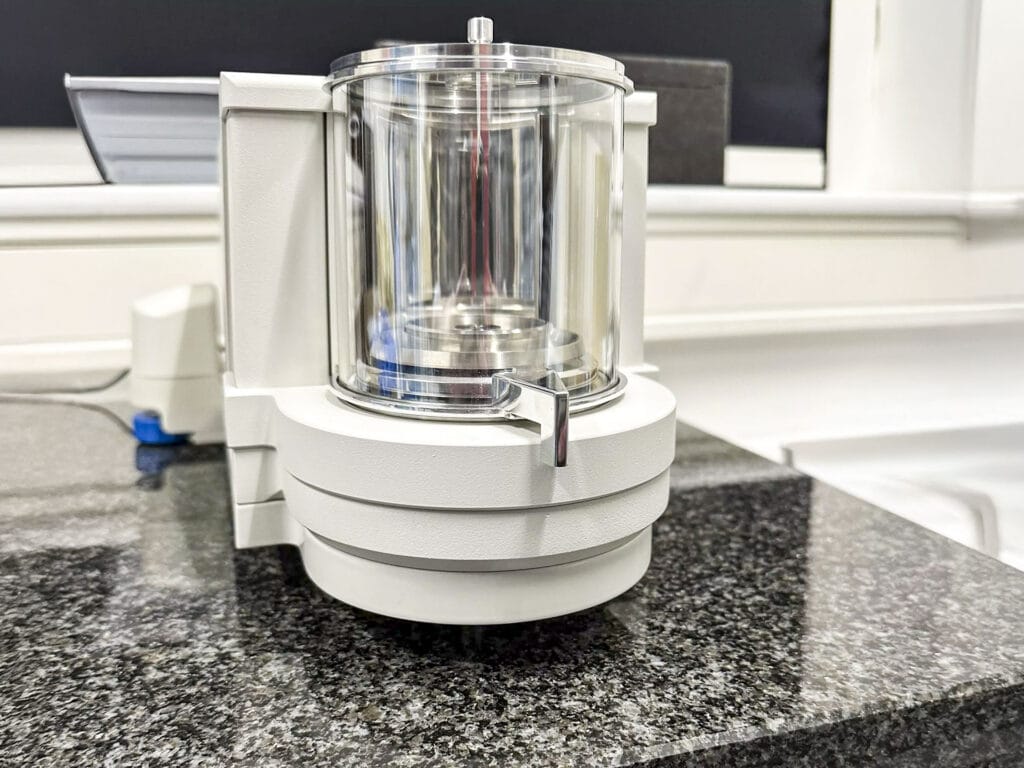
Anyone preparing materials for modern laser and material experiments must dose quantities of substances so precisely that deviations in the 0.1-µg range must be measurable and reproducible. This is possible with an ultra-microbalance such as the ELLIPSIS UYA-6.5Y from Radwag, which we have just put into operation at the Max Born Institute in Berlin, for example. An extremely exciting technology that we would like to present here.
What is an ultra-microbalance and what is it used for?
One ultra-microbalance (also known as an “ultra-microbalance”) is the highest class of laboratory balance for determining the mass of extremely small samples. While classic analytical balances typically work in the milligram to 0.1 mg range, the readability of ultra-microbalances is 0.1 µg – that’s seven decimal places in grams!
Typical fields of application in the laboratory:
- Dosing and weighing of very small quantities (powder, crystals, additives, reference materials)
- Production of reproducible sample batches, e.g. for thin-film or material systems
- Mass determination on very small components/carriers (e.g. small substrates, micro parts)
- Quality assurance and documentation in highly sensitive processes
This makes an ultra-microbalance the tool of choice when the process or experiment depends on mass accuracy.
The model in focus: RADWAG ELLIPSIS UYA-6.5Y (0.1 µg)
The RADWAG ELLIPSIS UYA-6.5Y belongs to the ultra-microbalance class with 0.1 µg readability and a maximum weighing range of 6.1 g. The device is designed for accuracy under real laboratory conditions, i.e. where temperature fluctuations, air movements, electrostatic effects and vibrations can falsify the result.
Important technical key data from the manufacturer:
- Maximum load: 6.1 g
- Readability: 0.1 µg (= 0.0001 mg)
- Weighing surface: Ø 16 mm
- Stabilization time: approx. 4-12 s (depending on profile/environment)
- Linearization / Accuracy: Linearity ±1.5 µg (model-dependent specification)
- Repeatability: up to 0.8 µg (max., specified laboratory conditions)
- Automatic internal adjustment/calibration
- Automatic leveling (Reflex Level System)
- 10-inch touch display on the terminal
- Interfaces: including USB, RS-232, HDMI, Ethernet, Wi-Fi/hotspot
Why draft shields and anti-vibration tables are mandatory for ultra-microbalances
With microgram weighing, even a breath of air contributes to the measurement error:
- Draughts (door, air conditioning, movement in the room) visibly shift measured values.
- Vibrations (impact sound, pumps, adjacent devices) prolong stabilization and increase scattering.
- Electrostatics (plastic containers, films, clothing) generate forces that act “like mass”.
The UYA-6.5Y is therefore consistently designed as an ultra-microbalance: an anti-draft chamber, which reduces air movements, is part of the concept as standard. For reproducible results, an anti-vibration table and – depending on the sample material – antistatic measures (e.g. ionization) are also recommended.
Use at the Max Born Institute: Weighing as part of reliable sample preparation
The commissioning of the ELLIPSIS UYA-6.5Y at the Max Born Institute for Nonlinear Optics and Short Pulse Spectroscopy (MBI) in Berlin is a good example of how weighing technology becomes decisive in cutting-edge research “in the background”.
The MBI researches ultrafast processes of light-matter interaction – from laser and measurement methods to phenomena in molecules, liquids, solids and nanostructures. In such working environments, precise weighing plays a role as soon as materials or samples with very small amounts of substance need to be prepared.
Among other things, the MBI works on experimental platforms where samples and materials often have to be provided in a highly reproducible manner. This typically includes (depending on the working group and experiment) activities such as:
- Weighing very small quantities of material for defined concentrations (e.g. solutions, doping)
- Preparation of samples/substrates for material and spectroscopy experiments
- Mass control of very small sample carriers or prepared layers
The benefits of the UYA-6.5Y a clearly lie in the reliable sample preparation and documentation in the micro- to sub-microgram range.
Ultra-microbalance in the laboratory: practical tips for stable results
If you want to use a microgram scale in everyday life, you will gain the most from a consistent routine:
- Location: Low vibration, away from doors, windows, air outlets.
- Warm-up and acclimatization time: Bring the balance and samples to room temperature.
- Handling: Work with tweezers, minimal heat input from hands.
- Electrostatic: Use antistatic aids (ionizer/antistatic kit), select suitable containers.
- Always close the draft shield: Only open the doors as far as necessary.
- Documentation: Record adjustment/environmental conditions (important for QA and auditability)…
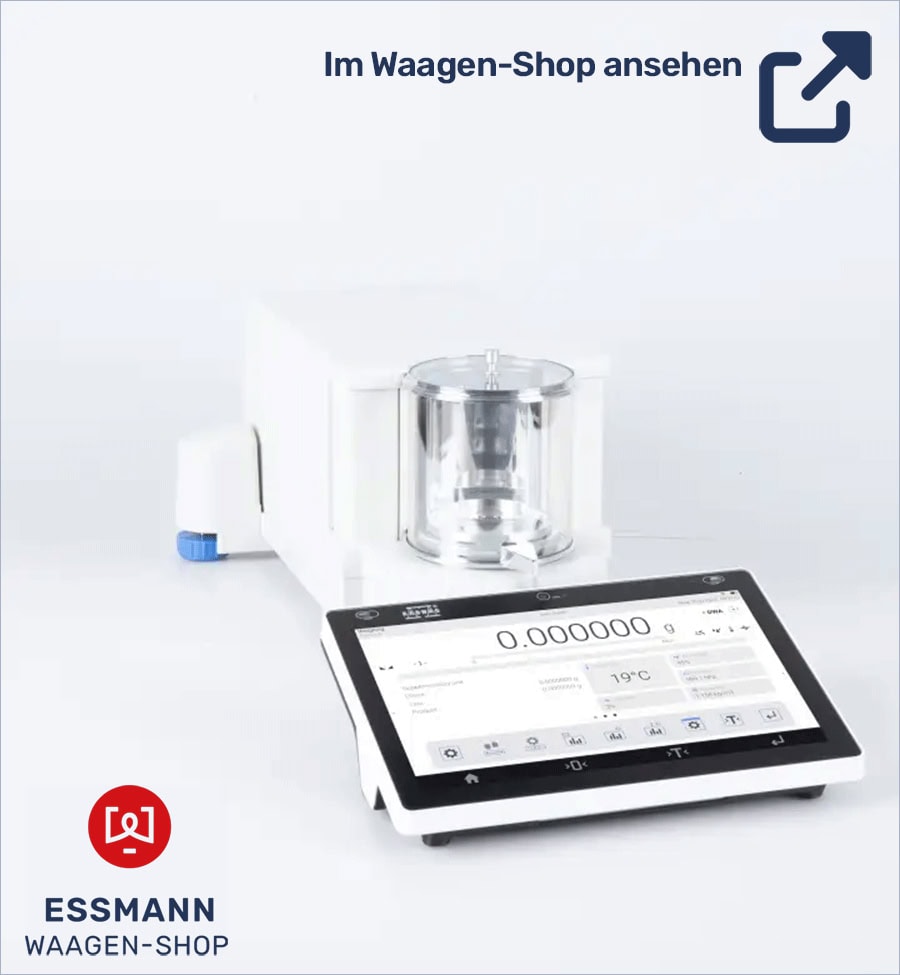
Availability: Buy ultra-microbalance in the ESSMANN Shop
The RADWAG ELLIPSIS UYA-6.5Y is also available in the ESSMANN store – including calibration capability/verification on request, depending on requirements). If you would like to buy an ultra-microbalance, it is worth checking the general conditions beforehand: Space, installation, process (weighing, documentation) and required interfaces.
Brief FAQ
What is the difference between a microbalance and an ultra-microbalance?
Microbalances typically have a readability of 1 µg, ultra-microbalances 0.1 µg – i.e. an additional decimal place and higher environmental requirements.
Why do you need an ultra-microbalance in the laboratory?
For tasks where the smallest differences in mass are relevant: Weighing, dosing, comparison of samples, strictly documented processes.
Why does a microgram scale need a draft shield?
Because even slight air movements can visibly falsify measured values in the µg range.
Is an anti-vibration table really necessary?
For ultra-microbalances: very often yes – it reduces scattering, shortens stabilization and increases reproducibility.
Summary
The commissioning of the RADWAG ELLIPSIS UYA-6.5Y ultra-microbalance at the Max Born Institute shows how crucial weighing technology can be for modern research: not as a side-show, but as the basis for reproducible samples and reliable data.
If you would like to check whether an ultra-microbalance is suitable for your laboratory processes (and which installation and accessory requirements make sense), we will be happy to support you – with a practical focus on measurement reliability, documentation and suitability for everyday use.