Scale Manufacturing Since 1860
The History of ESSMANN Scale Manufacturing
On July 1, 1877, the Imperial Patent Office began operations. That very same day, Christian Moritz Westphal of Wandsbek filed a patent for tabletop scales. His workshop, founded in 1860, is the origin of ESSMANN | Scales & Automation.

Since then, company names, owners, and locations have changed several times, but the focus on scale manufacturing has remained: from tabletop scales in Ottensen to crane scales, wire-pull scales, and large-capacity scales, all the way to truck scales, service, and proprietary weighing software. Here you will find the milestones of this history, documented with patent specifications, registry entries, and contemporary sources.
1877
Imperial Patent No. 955 for tabletop scales, filed on the first working day of the Imperial Patent Office
6.000
According to the 1889 exhibition catalog, the Ottensen factory produced tabletop scales that year
40 + 8
Patents and utility models from 1877 to 1972, filed in six countries
3
Historical scales from our production facility have been preserved in Hamburg, Lauenburg, and Lübeck
Stations Since 1860
1860-1878
Christian Moritz Westphal’s Workshop
Christian Moritz Westphal, born in 1833 in Bakede—now a district of Bad Münder am Deister—opened a locksmith’s shop in Wandsbek in 1860. At that time, Wandsbek belonged to Holstein, not to Hamburg. In 1873, Westphal had his business entered in the commercial register.
His Imperial Patent No. 955 from 1877 describes a guide mechanism for top-pan balance scales—that is, scales with the pans positioned above the lever mechanism. Westphal died on November 7, 1878. The company has borne the name Eßmann only since it was taken over by his nephews.
1879-1919
Essmann Brothers & Co. in Ottensen
After Westphal’s death, his nephews Albert and Ludwig Eßmann continued to run the business. In 1879, the workshop moved to Ottensen due to changes in customs regulations. Operating under the name Gebr. Essmann & Co., it became the Ottensen Scale Factory, which moved into a new factory building on Barnerstraße in 1888.
At the 1889 Hamburg Trade and Industry Exhibition, the company was awarded a bronze medal. The exhibition catalog lists 40 workers, a 10 PS steam engine, and an annual production of approximately 6,000 table scales, 2,000 decimal scales, and 150 centesimal scales, shipped as far as Australia. These were soon joined by vehicle, railroad, crane, and livestock scales, and, starting in 1898, gas meters as well.
In 1905, the company filed a patent application for a “weighing device for lifting machines with roller hoists,” which was published in 1907 as DE 187817. It is one of the earliest patents for crane and wire-rope scales, a field in which Eßmann remained active for decades. The technical handbook *Handbuch des Wägens* (1985) features an illustration of a slewing crane with a wire-rope scale manufactured by Eßmann. In 1914, the factory employed about 100 people.
1919-1936
Two Companies and the Alesco High-Speed Scale
On January 1, 1919, the brothers went their separate ways. Albert Eßmann continued to run the Ottensen-based scale factory Albert Essmann & Co., specializing in large scales, while Ludwig Eßmann founded his own scale and gas meter factory in Bahrenfeld. Today’s ESSMANN line traces its origins back to Albert’s company.
In the 1920s, the company filed patent applications for crane scales in Great Britain, the United States, Switzerland, and Austria. Albert’s son, Heinrich Eßmann, developed a tilt-switch scale, which went on sale in 1926 as the “Alesco Quick Scale.” By 1929, the company employed about 200 people, and in 1931, Heinrich Eßmann took over as head of the company.
On April 26, 1935, Alesco’s non-unloading road vehicle scales received approval from the Reich Institute for Physics and Technology. In December of that same year, the workforce celebrated 75 years of scale manufacturing.
1936-1959
Erika Eßmann and Rosalia Stolla
Heinrich Eßmann died on April 10, 1936, at the age of 44. His widow, Erika Eßmann, became the owner, while Rosalia Stolla became an authorized signatory and, in 1939, a partner and manager of the company. She led the company through war, destruction, and reconstruction. In the late 1930s, the company was renamed Albert Essmann & Co. Waagenfabrik Alesco.
In 1945, bombs destroyed large parts of the factory and offices. Following the currency reform of 1948, the company rebuilt its operations, including its own apprentice workshop. The Alesco switch-type weighing scale from 1955, located in Shed F at the Lübeck harbor, dates from this period. In 1956, the company filed a patent application for a method of electronically monitoring sampled weighing results.
The World Wars: Coming to Terms with the Past
How the company fared during the two world wars, what contracts it held, and whether prisoners of war or forced laborers were employed have not yet been investigated. We are researching this using archival sources and will update this page as soon as reliable findings are available.
1960-1998
Horst Eßmann: From Mechanics to Electronics
In 1960, the commemorative publication “100 Years of Scale Manufacturing” was released; around this time, Horst Eßmann assumed leadership of the company. In the late 1960s, the company obtained its first patents for electromechanical scales. In 1973, he founded Horst Eßmann GmbH, which he managed together with Gisela Eßmann.
Starting in 1975, the company switched to electromechanical scales and weighbridges made of precast concrete components. From 1976 to 1994, the company was headquartered in Halstenbek; thereafter, it returned to Hamburg, where it also adopted its current name, HE Wägetechnik Horst Eßmann GmbH. In 1987, Michael Eßmann joined the company.
1998-2021
Michael and Manuela Eßmann: Weighing on the Computer
In 1998, Michael and Manuela Eßmann took over as managing directors. This period saw the introduction of PC-based weighing systems, the EWP weighing software launched in 1999, and dynamic rail scales. With locations in Berlin, Stuttgart, and Rostock, the company’s service expanded beyond Hamburg.
since 2021
The ESSMANN Group
In April 2021, Michael and Manuela Eßmann handed over the company to Fabian Ehmke and Gregor Graßl; René Teichmann joined shortly thereafter. On September 1, 2022, ESSMANN merged with WHI Wägetechnik from Hamburg-Wilhelmsburg; since then, the company has also been involved in online sales of scales.
In the fall of 2024, the West branch opened in Wallenhorst near Osnabrück. Effective January 1, 2025, Wägetechnik Heinz Visser GmbH of Duisburg became part of the ESSMANN Group. In 2026, the EWA software platform—the successor to EWP—was launched.

Where our scales are available
Museum of Work, Hamburg-Barmbek
A wagon scale manufactured by Essmann & Co., built between 1879 and 1919, located on the former site of the New-York Hamburger Gummi-Waaren Compagnie.
Lauenburg/Elbe, Bahnhofstraße
The public weighbridge was built in 1914 and remained in operation until around 1970. According to the Route of Industrial Heritage, the weighing technology dates back to [year missing]. (opens in new tab) by Essmann. A surviving company sign bears the later name “Albert Essmann & Co. Waagenfabrik Alesco”; when it was installed is still unclear.
Lübeck, Warehouse F
An Alesco lever-type scale from 1955, last calibrated in 1991. Building F on the Northern Wall Peninsula is currently undergoing renovation; the scale is not currently in operation. The developer would like to preserve it.
Do you know of any other surviving scales made by Essmann or Alesco? We’d love to hear from you and see any photos you might have.
“Weigh” or “weigh”?
Both words are correct. In everyday language, people say “wiegen,” but in technical terminology, “wägen” has become the standard: load cell, weighing range, weighing technology. That is why “weighing technology” is part of our company name.
Sources
- Exhibition catalog for Altona-Ottensen at the 1889 Hamburg Trade and Industry Exhibition, No. 48: Digital copy from the SUB Hamburg (opens in a new tab)
- Patent publications DE 955 (1877) and DE 187817 (1907): DEPATISnet, German Patent and Trademark Office (opens in a new tab)
- Manfred Kochsiek (ed.): Handbook of Weighing, Vieweg 1985, pp. 12–14: DOI 10.1007/978-3-322-90126-2 (opens in a new tab)
- Historical brochures and photos: Wikimedia Commons (opens in a new tab)
- ESSMANN Company Archives: Chronicle, commemorative publications from 1910, 1950, and 1960, list of patents from 1877 to 1972, and extracts from death and commercial registers. As of November 2026
We are scale manufacturers.
In 1877, the focus was on operating a platform scale; today, it’s on truck scales, load cells, and software. The mission has remained the same: to reliably determine weight. If you’re looking for a partner who has been manufacturing and servicing scales since 1860, contact ESSMANN | Scales & Automation.
Contact scale manufacturer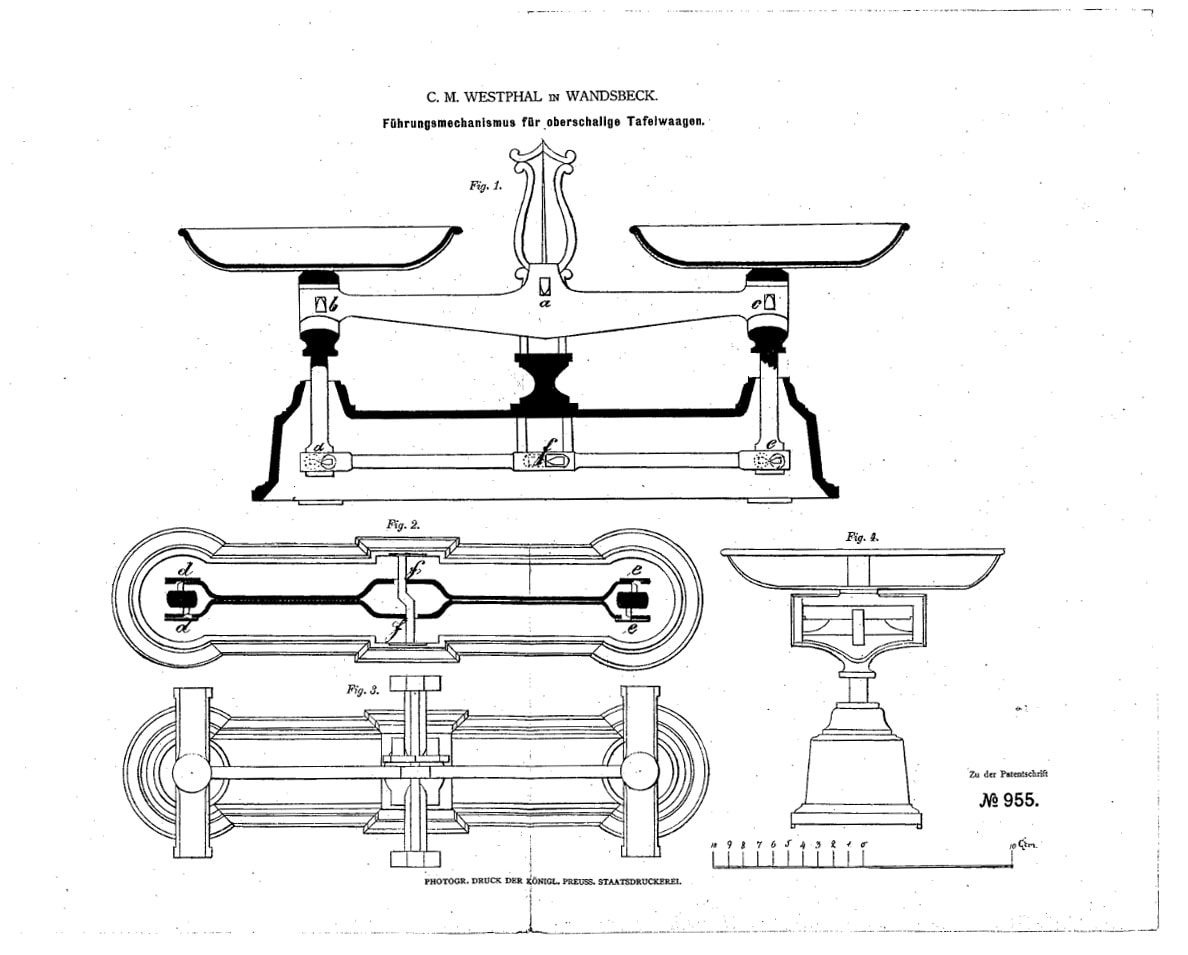
Scale builder tip: Weighing or weighing?
The verbs "weigh" and "weighing" are both used to determine weight, although "weighing" is generally more common. In the professional field, however, the term "weighing" is more commonly used to determine the weight of a mass. Both terms are accepted by the Duden dictionary, although "weighing" is colloquially regarded as an outdated variant.
In the professional field, however, "weighing" has established itself as the exact term for the process of determining weight with the help of a scale. We still use the term today in the words "weigh" and "consider".
Both words are derived from the Germanic word "wigan", which means "to move" or "to swing".